top of page

ree

Types of Entity for Registration in Thailand

  • Representative Office: Research only & Non-revenue generating

  • Branch: like Foreign registration & Can generate income

  • Limited Liability Company: Standard limited company

  • BOI Promotion: Specific eligible activities approved by Board of Investment


Considerations for Business in Thailand

  • What kind of business you are going to run in Thailand?

  • Will you 100% own the Thai company or there be a potential Thai partners?

  • Will the business involve the eligible activities (https://www.boi.go.th/index.php?page=eligible_activities) ?

  • Will you allocate staff from home country to Thailand?

  • How much capital available to invest in Thailand?


Tax Types


Companies incorporated in Thailand are taxed on worldwide income. A company incorporated abroad is taxed on its profits arising from or in consequence of the business carried on in Thailand.


The corporate income tax (CIT) rate is 20%. However, if company with paid-up capital less than 5 million baht, the tax rate would be lower.


Tax Filing and Payments


Any Thai or foreign company carrying on business in Thailand must submit their tax returns (CIT 50/51 form) and payments twice a year.


For the International Transportation Business, a company shall submit tax return (CIT 52 form) and payment within 150 days after the closing date of the Accounting Period (which shall be within 12 months from its incorporation date)


Need Assistance?


Please feel free to contact us at info@rbcs.com.hk


RUMBLE CORPORATE SERVICES LIMITED (Company No.3055304) is a holder of TCSP License No.TC007775 which is granted to carry on company service business in Hong Kong. RBCS is also a proud member of One SMP LLP, an ASEAN based accounting and business advisory group dedicated to serving SMEs around the world wanting to do business in Asia. ASEAN consists of Singapore, Malaysia, Indonesia, Philippines, Thailand, Vietnam, Cambodia, Brunei, Lao PDR and Myanmar.


Straub Collaborative provides a bridge between retail clients and online customers with professional images that capture the essence of a brand.

ree

The old adage that a picture tells a thousand words has never rang more true than in this era of endless information. As commerce moves online, striking images to evoke a response become increasingly important for brands. Straub Collaborative understands the importance of visuals. Its team of photographers, stylists, project managers and developers work together to craft more than 100,000 images every quarter.


Go-To market faster in Hong Kong

The Hong Kong office was a natural extension for Straub as many of its apparel and footwear clients’ samples are produced in the region. “We believed that we could capture the sample imagery faster due to the proximity to manufacturing facilities. In turn, we can enable speed to market – a race to list that hot selling item online can really impact revenue generation.” explained Jenmon Jenkins, Straub Collaborative’s Managing Director for Asia Pacific. “During the pandemic, we were able to move projects between our American and Hong Kong studios to accommodate the production needs of our clients and when logistics were challenged. Boston sent projects to Hong Kong as the studio was in locked down. One of the advantages of our different studios is that we proudly work across time zones: when Hong Kong went home for the day, the American offices picked up where we left off for post-production.”


Jenkins feels that a strong image is the driver behind successful eCommerce businesses, as it forms the connection between a brand and a customer. “Unlike a physical store where you may have the best sales staff to connect and interact with you, eCommerce needs to elicit a meaningful response—whether it’s clicked to buy, lead you to further research on social media or share with a friend,” she elaborated. “The imagery needs to tell the story of the brand, and the product needs to be convincing. The art of photography fulfills a true need, and I see eCommerce continuing to play a huge role on retail’s evolution. Rather than traditional retail, there will be omni-channels where online, offline and social selling will become more blurred.”


Seizing opportunities during the pandemic

According to Jenkins, one major difference between clients in Asia and the US is that APAC’s pricing is more competitive than the US, and with shorter, frequently ad-hoc planning cycles for producing eCommerce assets. Some global brands tend to only use video for more premium products while in Asia, particularly in China, consumers expect that every product will come with a video and a lot more assets to showcase every single product. “The year 2020 gave us the opportunity to forge strong collaborations to resolve lockdown challenges and seize growth,” Jenkins noted. “We expanded to New York City and, looking ahead, we have exciting plans for Mainland China and Southeast Asia in progress with local partners.”


Although she revealed that high-level experienced stylists were difficult to find initially, the rise of eCommerce has resulted in more qualified candidates. “Talents are also attracted by the idea of training and perfecting their craft in the US for on-boarding and training,” Jenkins said. “Hong Kong also offers access to a diverse model pool, quality of talent and ease of operation. It is compact with a diverse landscape. It is the ultimate city for work life balance, a fantastic place to network and a great base to expand into the Greater Bay Area and Southeast Asia.”


Source: InvestHK 01.09.2021

Interview with Chitpol Mungprom, Founder of Zanroo

ree

Brands have traditionally relied upon surveys and research to understand their consumers, but these approaches have several shortcomings such as being time‑consuming and having limited sample sizes. As the number of digitally connected consumers grows and social media usage expands, social listening provides an alternative for brands as well as marketers to tap into much richer consumer insights in real‑time.


In Southeast Asia, social listening has profound implications for many core marketing functions – from consumer analysis to customer support to competitive intelligence – given the high social media penetration in the region. More than three out of five people in Southeast Asia are active social media users, with Malaysia having the highest penetration rate of 86%.[1] In view of the today’s digital marketing climate in Southeast Asia, HKTDC Research sat down with Chitpol Mungprom, Founder of Zanroo, to understand how social listening and digital marketing works in the region.


ree

Understand Consumers Through Social Data

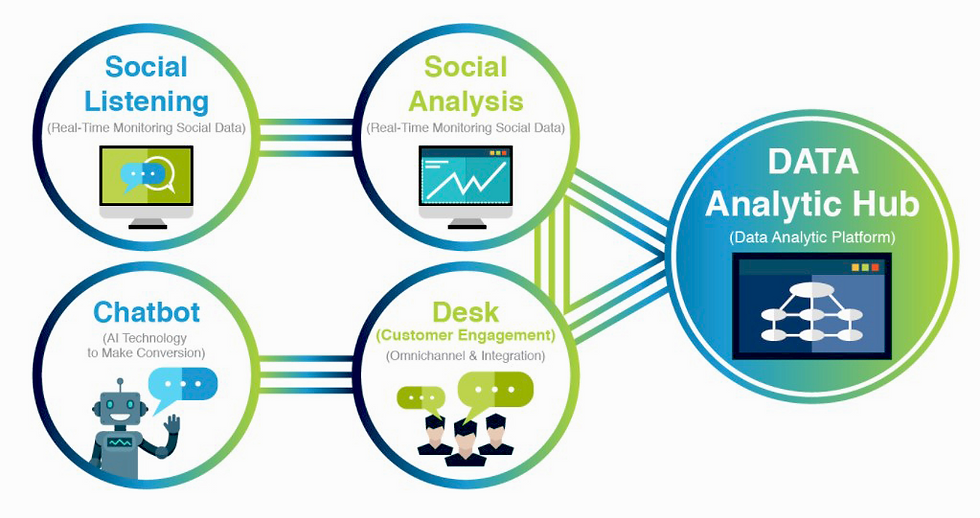
Founded in 2013, Thailand‑headquartered Zanroo provides business intelligence tools that track, monitor, collect and analyse online conversations across social media platforms and websites. Sharing the key benefits of utilising social data, Mungprom said: “For any brands to succeed, it is important to know your target consumers so that you can direct your marketing efforts towards the right audience and yield better results. Our social analytics solution can understand the diverse local languages in Southeast Asia, such as Thai, Bahasa and Tagalog, and offers a window into consumers’ positive and negative feelings towards a brand and its products and services. It also shows what trends consumers are interested in.”


Apart from consumer insights, social data informs marketers and brands about the competitive landscape. Mungprom elaborated: “Through social listening and monitoring, a company is able to get honest comments and feedback about brand loyalty, and the strengths and weaknesses of its competitors. With this information, it can look at ways to differentiate itself from other market players.”

As a mobile‑first region, Southeast Asia has made its way into the radars of many digital marketers given its high social media penetration, with almost seven out of ten people in the region being active social media users.[2] Understanding the centrality of social media to ASEAN consumers’ shopping experiences and interactions with brands, Mungprom expanded his business to cover all ASEAN markets with offices in Malaysia, Indonesia and Singapore.


ree

Moving Forward to Data Technology and AI


Mungprom shared that social listening techniques have been around for some years and becoming more common in consumer‑facing industries. To differentiate Zanroo from other marketing technology companies, Mungprom believed that it was essential for the company to utilise data technology and analytics for more dynamic consumer insights. He said: “In Thailand, the industry has reached a consolidation stage for social listening technology. It is key for us to improve our offerings and solutions and bring the business to the next level. Instead of just tracking conversations online, we’re looking to predict consumer and industry trends with the data we have.”


One highlight of Zanroo’s enterprise solution is to help brands match online and offline consumer data. Elaborating on this, Mungprom said: “Online data usually originates from various points across the customer journey such as online transactions, customer service chat logs and browser cookie data while offline data includes purchase history in physical stores and loyalty card information.


In today’s world, consumers demand consistency across communication channels. By integrating online and offline data, we’re able to identify and match the customer who visited the brick‑and‑mortar store with his or her online interactions with the brand, and hence achieving a truly omni‑channel experience. At the same time, we are able to create more comprehensive customer profiles and bolster our marketing efforts for brands to attract new customers or convert potential customers.”


In anticipation of heavier adoption of artificial intelligence (AI) in the future, Zanroo also provides chatbot solution to help brands engage with their customers. Mungprom pointed out that the Covid-19 pandemic has indeed brought AI chatbots into the spotlight for many brands and marketers in Southeast Asia, saying: “The pandemic has taken a toll on physical retail stores and brands are looking for alternative ways to connect with their customers and improve shopping experiences. Over the past year, we have seen more businesses adopting chatbots to automate responses to customer inquiries and help strengthen connections with customers.” While chatbots can offer a better conversational experience for the customer, Mungprom advises businesses to always provide an alternative means of communication by giving customers the option to contact human customer service agents when needed.

ree

Tips for Effective Marketing


Against the backdrop of the pandemic and the subsequent structural shifts in consumer behaviours, the significance of digital marketing cannot be understated. To deliver resounding success in social media marketing, Mungprom has identified some useful strategies for brands. He emphasised the importance of consistency: “Consistent content allows for top of the mind awareness. It’s usually not the initial message that grabs the consumer’s attention but the subsequent exposures to the content. Social media is fast‑paced by nature, and content becomes obsolete quickly. That’s why posting regularly is so essential. Besides, brands also need to engage customers consistently and swiftly on social media platforms to build up credibility online.”


Whilst the region is highly active on social media, its cultural diversity means that taking a one‑size‑fits‑all approach in marketing is ineffective. Mungprom explained using Malaysia as an example, saying: “ It is a multi‑cultural and multi‑racial country with Malay, Indian and Chinese communities, and it is a melting pot of different religions and festive celebrations. Being culturally sensitive when communicating with the audience is vital.


“For example, a food and beverage company should be mindful about the month‑long Ramadan fasting period. It would be useful to understand how and when Muslims fast during Ramadan –from dawn to sunset – and adjust the advertising or marketing campaigns accordingly.”


While social media platforms including Instagram and Tik Tok are widely used to engage with customers in Southeast Asia, especially among Millennials and Gen‑Z, Mungprom suggested that traditional marketing channels such as billboards and TV broadcast remains effective for certain groups of target customers. Mungprom said: “We have worked with a client who sells personal care products in Thailand and the company spent the major part of its budget on street and bus stop billboards rather than on online social media campaigns. Knowing your target audience before choosing the right marketing channels is important for any kind of marketing to be effective.”

News: Blog2

Subscribe Form

Stay up to date

Thanks for submitting!

News: Subscribe
bottom of page